Login
Register

A new TM Forum survey shows Open Digital Architecture is central to telco transformation and is evolving into an AI native blueprint accelerating interoperable, industry wide innovation.
 Mark Newman, TM Forum
Sponsored by:

Towards an AI-native ODA
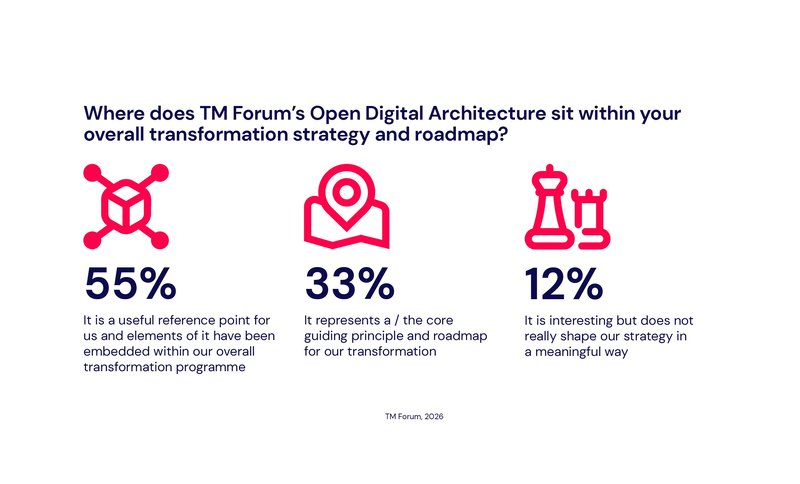
In a new TM Forum survey of more than 200 IT executives at 117 operators, one in three respondents said that TM Forum’s Open Digital Architecture (ODA) was the core guiding principle for their transformation. A further 55% said that they have already embedded elements of it within their overall transformation program.
The results indicate the extent to which the ODA has become an architectural blueprint and a reference for telecoms operators that are transforming the IT systems that support their customers, their networks and their businesses.
Telcos have been using the ODA as a toolkit and set of processes and guidelines to plan, design, build and operate a cloud-native telco. Now, as they are putting AI front and center of their technology roadmaps, the industry is evolving ODA to deliver on the benefits of AI-enabled solutions and to serve as a catalyst for AI innovation.
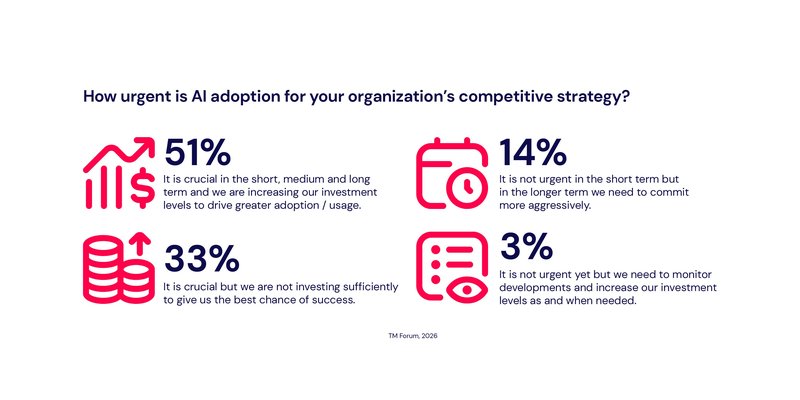
In our survey more than half respondents said that AI adoption was crucial in the short-, medium- and long-term and that they were increasing their investments in AI accordingly. A further one in three recognized that AI adoption was crucial to their businesses, but that they needed to increase their investment.
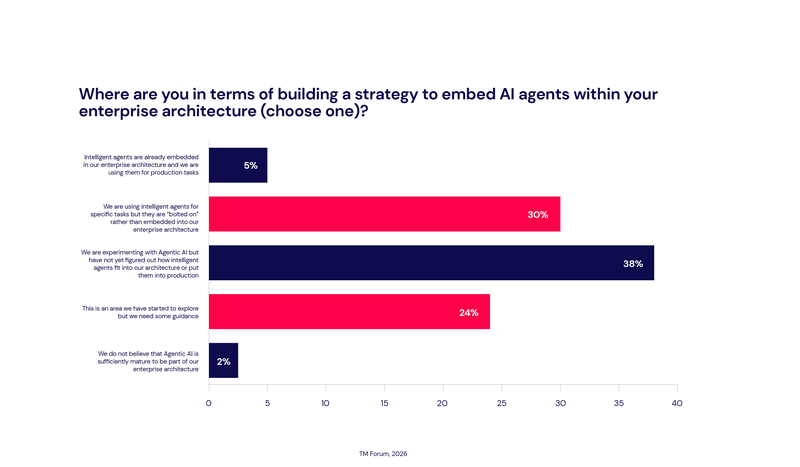
However, despite the expectations for AI, evidence today suggests it is not delivering in a meaningful way for business processes across the organization. There are a multitude of reasons why this is the case – from accuracy to data quality through to skills availability. But the data coming back from operators suggests that while there has been some progress in terms of deploying “bolt-on” use cases, little progress has been made in deploying AI for larger business use cases that span multiple systems.
Initiatives are underway across different TM Forum collaboration and catalyst teams to build AI capabilities and functionalities into the ODA.
There is already support for Model Context Protocol (MCP), the open-source standard which allows AI models to connect with external data sources, tools and applications, within ODA components, intent models and ontologies and autonomous closed loop domains.
A new initiative, Project Foundation, aims to deliver the telecoms industry’s first AI-native ODA Canvas Sandbox - a secure, collaborative, Kubernetes‑orchestrated environment where CSPs, hyperscalers, and technology partners can co‑develop, integrate, and test interoperable AI agents aligned with the TM Forum AI‑Native Blueprint. Its goal is to build a reference implementation of the AI-Native Blueprint extensions to ODA.
Andy Tiller, executive vice president for products and services at TM Forum, believes it is important for Project Foundation to demonstrate its value through a specific telco use case. “At DTW in Copenhagen in June we will showcase an AI-driven end-to-end fault resolution scenario managed by autonomous agents and ODA Components, built on Project Foundation,” says Tiller.
Across the technology ecosystem CSP partners are seeking to deploy AI capabilities in their solutions. Mona Nia, the global director for data and AI platforms at Tecnotree, believes that operators and vendors need to collaborate to define future standards and avoid architecture fragmentation.
“Without common foundations every operator is building AI differently and creating siloes that will haunt us for a decade. The industry stands at a crossroads. We can either fragment with CSPs and vendors building proprietary AI stacks that do not interoperate or we can do what we did with the ODA where we come together, develop common standards and build ecosystems.”
Later this month TM Forum will publish a research report, entitled Towards an AI-native ODA, which looks in more detail at the work that is underway across TM Forum. It will also include analysis from Tecnotree, which is already involved in many of these initiatives, into some of the key AI drivers and building blocks for future AI-enabled enterprise architectures.